
2026 Mosquito Surveillance
Adult Mosquitoes (carbon-dioxide trap data)

Adult mosquito counts in September were near average. Culex pipiens was the most frequently collected mosquito species, followed closely by Culex erythrothorax. Both species prefer to feed on birds and can play a role in the West Nile virus transmission cycle. At times, they can transmit the virus to humans, particularly Culex pipiens, which is commonly found in residential neighborhoods. Culex erythrothorax breeds in ponds and marshes containing tules (cattails).
The table below shows the average number of adult female mosquitoes collected per trap per night in September compared with the five-year average. The line graphs on the next page show the average number of mosquitoes from each of the six most common species collected per trap per night by month in 2026, along with the corresponding five-year monthly averages.
| Species | September 2026 | 5-year September average |
|---|---|---|
| _Culiseta pipiens_ | 5.0 | 6.7 |
| _Culiseta erythrothorax_ | 4.2 | 6.4 |
| _Culiseta incidens_ | 0.7 | 1.2 |
| _Culex tarsalis_ | 0.7 | 1.2 |
| _Aedes washinoi_ | <0.1 | 0.1 |
| _Aedes sierrensis_ | 0.0 | <0.1 |
This chart shows the 5-year average number of mosquitoes collected per trap night by month for the previous 5 years. Data are shown for the six most common species found in San Mateo County.
Larval Mosquitoes (collections from water sources)
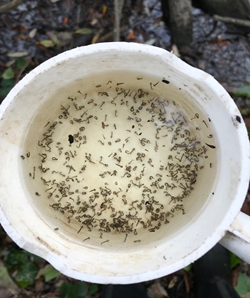
During September, mosquito larval samples were collected from a variety of areas, including backyard fountains and fishponds, water under buildings, storm drains, containers in yards, and other residential sources. District staff collected 160 larval samples during this month. Technicians use a dipper to take samples of water and visually inspect them for mosquito larvae. If larvae are present in a sample, it is taken back to the District laboratory for species identification.
The collected samples contained larvae from eight mosquito species. The most frequently detected species in September was Culiseta incidens (present in 54% of samples). This mosquito breeds year-round and is frequently collected from fishponds, containers holding water, and freshwater impounds. Technicians have been sampling these types of sources in an effort to detect invasive Aedes species, which often breed in suburban water sources.
The mosquito species Aedes aegypti was detected in larval samples for the first time in ten years. This invasive mosquito aggressively bites humans and other mammals. It can transmit pathogens that cause several diseases, including yellow fever, dengue fever, Zika and chikungunya. District staff are working diligently to detect this mosquito and eliminate all breeding sources in the neighborhoods where it has been found this year.
Page last reviewed: October 8, 2026